“Cyber Sovereignty”:
Making Asia-Pacific Less Secure, Not More?
Written by:

Principal Consultant
Sapience Consulting
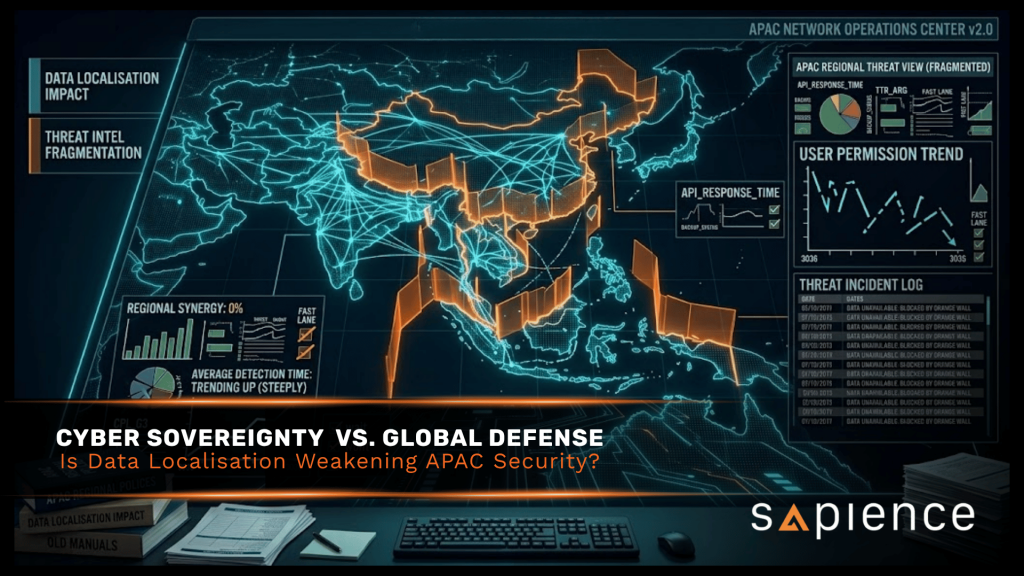
Over the past decade, cyber sovereignty has become a defining concept in global internet governance debates. Framed as a way for states to protect national security, citizens’ data, and domestic digital economies, cyber sovereignty often manifests through data localisation laws—rules that require data to be stored or processed within national borders.
Nowhere is this trend more pronounced than in the Asia-Pacific (APAC) region. Strong localisation pushes in India, Indonesia, and China are reshaping how organisations operate, collaborate, and defend themselves against cyber threats.
While proponents argue that localisation strengthens control and resilience, the reality for cybersecurity is far more complex. In a threat landscape defined by speed, scale, and global interconnection, restricting cross-border data flows may paradoxically make the APAC region less secure, not more.
[ GLOBAL THREATS ]
Machine-Speed Attacks & Borderless Cybercrime
DANGEROUS ASYMMETRY
[ FRAGMENTED DEFENCE ]
Data Localisation Laws & Segmented SOC Silos
Cybersecurity Is a Global Team Sport
Modern cyber threats do not respect national borders. Ransomware gangs operate across continents, botnets span thousands of compromised machines worldwide, and zero-day exploits are weaponised globally within hours. The backbone of effective cyber defence is global threat intelligence sharing—the real-time exchange of indicators of compromise (IOCs), attack signatures, behavioural patterns, and adversary tactics.
Multinational enterprises, cloud providers, and security vendors rely on centralised data lakes to correlate attacks seen in one region with anomalies detected elsewhere. This model allows defenders to move faster than attackers. When data localisation mandates restrict the movement of logs, telemetry, or user behaviour data, that feedback loop weakens.
The prevalence of cross-border cyber-related attacks like recent scam syndicate crackdowns in Cambodia highlights the vital importance of such information sharing. In APAC, where many organisations already face skills shortages and uneven cyber maturity, fragmentation of threat intelligence can be especially damaging.
Regional Breakdown: Sovereignty in Action
So how can organisations respond faster without sacrificing governance, ethics, and accountability? The solution isn’t abandoning governance – that would be reckless and unsustainable. Instead, organisations must evolve their governance frameworks to be as dynamic and responsive as the threats they face. Here’s a roadmap for achieving that crucial balance:
India:
Balancing Digital Nationalism and Global Integration
India’s evolving data protection framework reflects a strong push toward digital sovereignty. Provisions emphasising local storage of sensitive or critical data are often justified on grounds of privacy, law enforcement access, and national security. However, for global organisations operating in India, these requirements introduce operational friction:
Segmented Detection: Security operations centres (SOCs) accustomed to analysing global datasets must now segment Indian data into separate environments, limiting the ability to detect “low-and-slow” attacks that only become visible through regional correlation.
The Resource Gap: Smaller Indian firms often lack the capital to build robust, localised security infrastructure, leaving them more exposed.
A Two-Tier Ecosystem: Compliance-driven security duplication risks creating a divide between large, heavily funded enterprises and vulnerable smaller firms operating in isolation.
Indonesia:
Localisation and Compliance Complexity
Indonesia has pursued data localisation to assert digital sovereignty and encourage domestic cloud and data centre investment. For organisations in finance and critical infrastructure, compliance often requires working with local providers or maintaining parallel systems:
Siloed Threat Data: Intelligence sharing becomes complex when security logs cannot flow smoothly to regional or global SOCs.
Capability Gaps: Local providers may not always possess the breadth of global threat telemetry available to international hyperscalers.
Slower Incident Response: As cybercrime targeting Southeast Asia escalates, these constraints risk delaying collective response efforts.
China:
A Highly Controlled Digital Ecosystem
China represents the most comprehensive expression of cyber sovereignty, enforcing strict controls over data flows, security reviews, and cross-border transfers:
Architectural Isolation: Multinational companies are forced to run China-specific SOCs disconnected from global monitoring environments. Defenders are effectively siloed while attackers remain unconstrained.
Response Friction: Coordinating cross-border investigations becomes legally complex and slow, significantly increasing dwell time and potential impact.
Organisational Impact: Cost, Complexity, and Risk
Across APAC, data localisation has reshaped how organisations work:
Higher Costs: Maintaining duplicate data centres, SOCs, and compliance teams drives up overhead.
Reduced Visibility: Segmented data pools limit holistic threat correlation.
Slower Response Times: Legal and technical barriers delay urgent cross-border investigations.
Vendor Constraints: Organisations are frequently forced to choose local providers over best-of-breed global solutions.
Compliance vs. Security: Pressures risk shifting enterprise focus away from proactive threat hunting toward box-ticking compliance.
The Broader Shift: How Behaviours Are Changing
1. Security by Geography, Not by Design:
Companies risk prioritising where data sits over how well it is protected, mistaking physical location for actual security.
2. Reduced Collaboration:
CISOs and security leadership may become more inward-looking, sharing less telemetry with global peers due to legal uncertainties.
3. Innovation Slowdowns:
Startups and SMEs may avoid regional expansion due to compliance complexity, stifling competition.
4. The User Trust Paradox:
While localisation is marketed as protecting citizens, major breaches caused by restricted intelligence sharing could ultimately erode public trust.
A Path Forward: Sovereignty Without Isolation
Cyber sovereignty and effective cybersecurity do not have to be mutually exclusive. Policymakers in APAC can pursue interoperable frameworks that permit regulated, secure cross-border threat intelligence sharing while respecting national laws:
Anonymised Telemetry Carve-Outs: Exemption paths for threat indicators and non-identifiable telemetry logs.
Standardised Legal Agreements: Pre-vetted mechanisms for cross-border incident response collaboration.
Trusted Regional Exchanges: Establishing regional intelligence hubs that bridge national regulatory frameworks.
In an economically interconnected region like APAC, security through isolation is an illusion. Cyber resilience depends not on absolute isolation, but on structured cooperation.
Conclusion
Data localisation laws in India, Indonesia, and China reflect legitimate national concerns. Yet when applied rigidly, they risk undermining the very cybersecurity goals they aim to achieve. In a world where attackers collaborate globally, defenders cannot afford to retreat behind digital borders. For APAC, the challenge ahead is clear: build cyber sovereignty that strengthens security through collaboration, not fragmentation.
As a trusted leader in professional development, Sapience empowers you to invest in your future.
Don’t wait – Explore our available funding and leverage our expertise to upskill without financial strain.