Securing Innovation Against Next-Generation Risks
Imagine your organisation has fully embraced artificial intelligence across multiple business functions. Customer service teams rely on AI-powered chatbots, developers use coding assistants to accelerate software delivery, and employees leverage generative AI to draft documents and analyse complex data.
Productivity has never been higher. Yet when the Chief Information Security Officer asks a simple question—“Where are our AI risks?”—the room falls silent.
Everyone understands AI is changing the business, but few can visualize how an attacker might exploit these systems or where the organisation is most vulnerable.
This is where threat modelling becomes invaluable. Rather than reacting to incidents after they occur, threat modelling provides a structured methodology to identify, visualise, and prioritise security threats before they become business risks. As AI adoption continues to accelerate, organisations require approaches specifically designed for AI environments rather than relying solely on traditional cybersecurity methodologies.
In this article, we explore how AI threat modelling, supported by the MITRE ATLAS framework, enables organisations to better understand their AI attack surface, prioritise security investments and strengthen governance. We will demonstrate how organisations can transform complex AI security challenges into actionable security strategies that support both innovation and resilience.
1. AI Introduces New Attack Paths That Traditional Models Miss
Traditional applications have well-understood attack vectors. Security professionals are familiar with conventional threats such as SQL injection, privilege escalation, and malware infections. AI systems, however, introduce an entirely new category of risks.
Instead of attacking software code directly, adversaries may manipulate the AI model itself. Common AI-specific attack paths include:
- Data Poisoning: Manipulating training data to corrupt or influence model behavior.
- Prompt Injection: Crafting engineered prompts to bypass system safeguards and control outputs.
- Model Inversion & Data Extraction: Extracting sensitive, embedded information from trained models.
- Model Theft: Stealing proprietary machine learning models or intellectual property.
AI systems introduce risks that extend far beyond traditional cybersecurity boundaries. Organisations require security models designed to understand AI itself.
2. MITRE ATLAS: A Common Language for AI Threats
One of the biggest challenges organisations face is understanding how AI attacks actually occur. Unlike conventional cyberattacks, many AI-specific techniques remain unfamiliar to internal security teams.
The MITRE ATLAS (Adversarial Threat Landscape for Artificial-Intelligence Systems) framework addresses this challenge by cataloguing known adversarial tactics and techniques against AI-enabled systems. Similar to how the widely adopted ATT&CK framework provides a common language for enterprise threats, MITRE ATLAS focuses specifically on attacks targeting machine learning and AI environments.
MITRE ATLAS is more akin to a map rather than a checklist. Rather than asking whether an organisation has implemented a specific control, it explores questions such as:
- Where could an attacker influence our AI lifecycle?
- Which AI assets would be most valuable to an adversary?
- What specific techniques could be used against our models?
- Which existing security controls already mitigate these threats?
This structured approach allows both technical and non-technical stakeholders to visualise AI threats using a shared vocabulary. Security teams, developers, risk managers, and business leaders can collaborate effectively because everyone is evaluating the exact same attack scenarios.
Instead of viewing AI as a mysterious black box, organisations begin seeing a clearly defined threat landscape.
3. Visualising AI Threats Improves Risk-Based Decision Making
Threat modelling is not simply about identifying every conceivable attack—its real value lies in helping organisations prioritise the threats that matter most.
Consider a typical AI governance workshop using MITRE ATLAS to map an internal document summarisation platform. The exercise begins by defining critical AI assets:
- Training Datasets & Knowledge Bases
- Foundation Models & Fine-Tuned Weights
- User Prompts & System Context
- Model Outputs & Inferred Data
- API Integrations & Downstream Services
- Administrative Interfaces & Pipelines
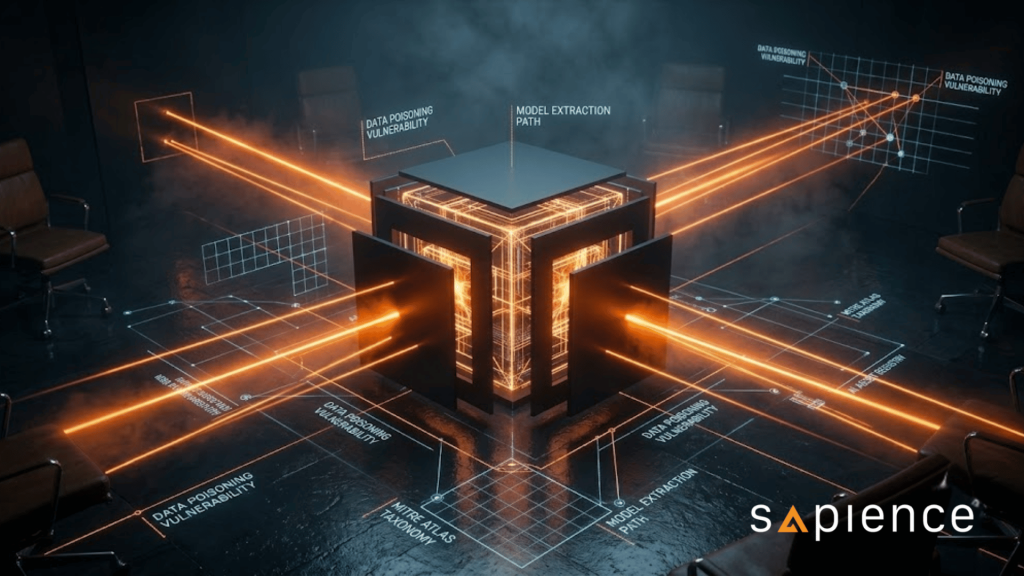
Participants then overlay potential attacker techniques from MITRE ATLAS across each component. This visual mapping quickly highlights key vulnerabilities:
⚠️ Key Risk Scenario: Employees could unintentionally expose confidential data through prompts submitted to external AI services. Simultaneously, malicious actors might exploit prompt injection techniques to manipulate downstream connected systems via unsecured APIs.
Rather than attempting to address every security issue simultaneously, the organisation can direct its resources toward the highest-impact risks first. This illustrates why threat modelling complements risk management so effectively. It transforms abstract AI concerns into concrete attack paths that decision makers can understand, communicate and address.
4. Building Security Into AI Projects From the Beginning
Perhaps the greatest benefit of AI threat modelling is that it encourages Security by Design.
Too often, security reviews occur shortly before production deployment. By then, architectural decisions have already been locked in, making mitigation expensive and disruptive. Performing lightweight threat modelling sessions during the earliest stages of AI development ensures critical questions are addressed upfront:
- What AI assets require special protection?
- What assumptions are we making about trust boundaries?
- How could an attacker manipulate model inputs or outputs?
- Which MITRE ATLAS techniques are relevant to this specific use case?
- What monitoring controls should be implemented post-deployment?
These discussions shift security from being a compliance activity to becoming a design activity. More importantly, they create a culture where developers, data scientists, cybersecurity professionals and business stakeholders collaborate throughout the AI lifecycle instead of operating in isolated silos.
Innovate Securely, Remain Resilient
Artificial intelligence presents organisations with tremendous opportunities, but it also introduces attack techniques that traditional security methodologies were never designed to address. As AI adoption continues to expand, organisations need practical methods to understand, visualise and communicate these emerging risks.
Threat modelling, supported by the MITRE ATLAS framework, provides exactly that capability. By mapping AI assets, identifying adversarial techniques and visualising attack paths, organisations can prioritise security investments, improve governance and build resilient AI systems from the outset. Rather than relying on assumptions or reacting after incidents occur, teams gain a structured and repeatable process for embedding security throughout the AI lifecycle.
At Sapience, our trainers and consultants combine internationally recognised frameworks with practical, hands-on experience to help organisations navigate the rapidly evolving AI security landscape. Through scenario-based workshops, AI governance programmes and cybersecurity training, we equip professionals with the skills needed to identify emerging threats and implement effective safeguards with confidence.
As AI becomes an integral part of every organisation, understanding how attackers think will become just as important as understanding how AI works. Explore Sapience’s AI security and cybersecurity training programmes to discover how threat modelling with MITRE ATLAS can help your organisation innovate securely while remaining resilient against the next generation of cyber threats.
Check out our IBF and SSG funded courses! There is no better time to upskill than now!

IBF Funding
IBF Funding