The AI Arms Race:
When Attackers Move at Machine Speed, and Defenders Are Stuck in Governance Gridlock
Written by:

Principal Consultant
Sapience Consulting
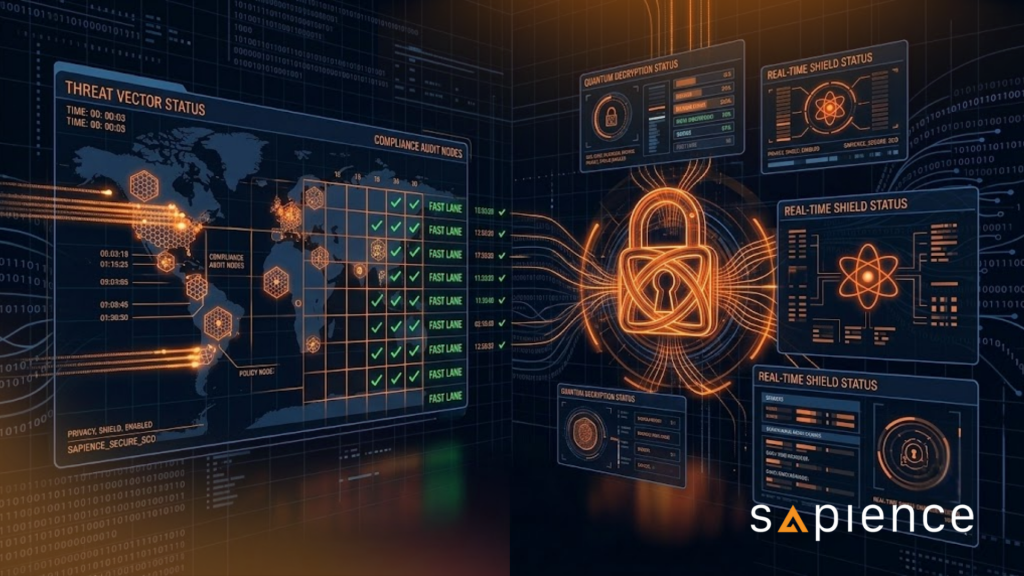
The digital battlefield is evolving at a breakneck pace, and the stakes have never been higher. Cyber attackers—unburdened by ethics, regulations, or corporate procurement cycles—are aggressively weaponising Artificial Intelligence (AI) to execute complex, high-velocity campaigns:
- Hyper-Realistic Phishing & Deepfakes: Bypassing traditional email filters and social engineering detection with ease.
- Automated Vulnerability Discovery: Scanning networks and exploiting zero-day flaws faster than human analysts can respond.
- Polymorphic Malware: Continually evolving underlying code to evade signature-based detection systems.
- Adaptive Campaign Optimisation: Analysing defense patterns in real time to shift attack vectors dynamically.
- Exponential Attack Scaling: Launching millions of highly tailored attacks simultaneously across global targets.
The result? Attacks are becoming more sophisticated, targeted, and devastating, unfolding at a pace that feels almost autonomous.
[ ATTACKERS ]
Unconstrained Speed & Autonomous AI
DANGEROUS ASYMMETRY
[ DEFENDERS ]
Governance Gridlock & Approval Delays
Meanwhile, on the Defensive Front: Security teams find themselves increasingly hamstrung. While attackers operate in the shadows with ruthless efficiency, defenders must navigate a complex labyrinth of governance:
- AI-Specific Oversight: Implementing new AI ethics boards, risk assessments for AI tools, and compliance with emerging AI regulations (like the EU AI Act).
- Traditional IT Governance: Enduring lengthy procurement cycles for new defensive tools (including AI-powered ones), change management boards, and rigorous testing requirements.
- Privacy & Data Regulations (GDPR, CCPA): Complying with Strict limitations on data collection, usage, and monitoring – data that is often crucial for threat hunting and AI model training.
- Compliance Frameworks: Maintaining adherence to rigorous standards such as ISO/IEC 27001, NIST, and SOC 2, where manual audit logs can slow incident response.
- Ethical & Legal Liabilities: Navigating the murky waters of defensive AI use – potential bias in algorithms, automated countermeasures causing collateral damage, legal liability.
Waiting weeks for a governance committee to approve a critical AI-powered threat-hunting tool while adversaries actively exploit a zero-day vulnerability is a recipe for disaster. The solution isn’t abandoning governance—that would be reckless. Instead, organisations must evolve their oversight frameworks to become as dynamic and responsive as the threats they face.
The Conundrum:
Attackers leverage AI with impunity to move faster and hit harder.
Defenders, burdened by necessary but often cumbersome governance, struggle to keep pace.
This creates a dangerous asymmetry where the advantage tilts decisively towards the aggressor. Waiting weeks for a governance committee to approve a critical AI-powered threat hunting tool while attackers are actively exploiting a zero-day is a recipe for disaster.
Striking the Critical Balance: Governance Agility for Cyber Resilience
So how can organisations respond faster without sacrificing governance, ethics, and accountability? The solution isn’t abandoning governance – that would be reckless and unsustainable. Instead, organisations must evolve their governance frameworks to be as dynamic and responsive as the threats they face. Here’s a roadmap for achieving that crucial balance:
1. Embed Security in Governance Design (Shift Left Security for Governance)
Proactive Risk Assessment: Integrate cybersecurity risk assessments specifically for new governance processes. Ask: “How will this approval step impact our mean time to respond (MTTR) to a major incident?”
“Secure by Design” Governance: Design oversight mechanisms with agility in mind from the outset. Build in flexibility for emergency situations.
2. Create Adaptive Governance Tiers & Fast Lanes
Implement a Tiered Governance Model: Not all actions require the same level of oversight. For high-impact, real-time defensive actions (e.g., blocking IPs, isolating systems), implement pre-approved response playbooks governed by clearly defined risk thresholds. Reserve deeper reviews for strategic AI decisions like model deployment or policy changes.
Risk-Based Approvals: Categorise security tools, actions, and AI uses based on risk level. Low-risk/high-urgency actions (e.g., deploying a pre-approved signature update) need minimal oversight. High-risk actions (e.g., deploying a novel AI counter-attack tool) still require rigor, but the process should be optimised.
Pre-Approved Frameworks: Establish pre-vetted, approved frameworks for common defensive AI use cases (e.g., anomaly detection models using specific data types). Deploying within the framework triggers a streamlined process.
Emergency Protocols: Define clear “break-glass” procedures for imminent threats. This involves pre-defined authority chains for rapid approval of critical actions, with mandatory post-incident review and documentation. Governance enables speed in crises, rather than blocking it.
3. Automate Governance Where Possible
Compliance as Code: Use automation to continuously monitor and enforce compliance controls within security tools and processes. This reduces manual audit burden.
Automated Reporting: Implement tools that automatically generate the documentation required for governance and compliance, pulling data directly from security systems.
Adopt AI for Cyber Defence Responsibly: Use AI not just for offense detection but for predictive analysis, automated response, and threat hunting. Invest in AI models that explain their decisions (explainable AI) to meet governance standards while enabling faster reaction.
Governance-as-code : Just like infrastructure-as-code revolutionised IT, governance-as-code embeds policy rules into automation workflows. This enables defenders to act within governance parameters in real time without manual intervention.
4. Foster Close Collaboration & Shared Understanding through the establishing of Cyber Fusion Centres
Unified Mission: Security, Legal, Compliance, Risk, and IT leadership must align on the shared mission: enabling effective defense within the boundaries of responsible governance. Break down silos. These cyber fusion centers enable faster decision-making and reduce bottlenecks while ensuring compliance stays in the loop.
Joint Tabletop Exercises: Include governance stakeholders in incident response simulations. Show them the real-time consequences of delayed approvals. Foster mutual understanding of operational pressures and regulatory constraints.
Security Liaisons: Designate security personnel who understand governance language and can effectively communicate operational needs and risks to oversight bodies.
5. Invest in “Governance-Friendly” Defensive AI
Focus on Explainability (XAI): Prioritise defensive AI tools that provide clear explanations for their decisions. This builds trust with oversight bodies and eases ethical reviews.
Bias Mitigation: Proactively implement techniques to detect and mitigate bias in security AI models, addressing a major governance concern upfront.
Data Minimisation & Privacy by Design: Choose tools designed to work effectively with minimal sensitive data or incorporate strong privacy-preserving techniques (like federated learning, differential privacy) to align with privacy regulations.
6. Establish an “Ethical Red Team”
Cross-Functional Pre-Vetting: Create a cross-functional team (Security, Legal, Ethics, Compliance) tasked with proactively evaluating the ethical and governance implications of proposed defensive AI tactics and tools before they are needed in a crisis. This pre-vetting speeds up future deployment.
Continuous Training and AI Red-Teaming : Regularly test your AI defenses using simulated adversarial AI (red teaming) and update both defense models and governance policies based on findings.
Conclusion: Agility is the New Compliance Mandate
The cyber arms race is no longer about who has more tools—it’s about who can use them faster, smarter, and within the rules. While AI gives attackers an edge, organisations can level the playing field by marrying speed with structured agility. Governance shouldn’t be a bottleneck; it should be a smart accelerator.
The era of slow, rigid governance in the face of AI-accelerated threats is untenable. Organisations cannot afford to let bureaucratic processes become the weakest link in their cyber defenses. The attackers’ advantage lies in their lack of constraints; our defense must lie in building governance frameworks that are as intelligent, adaptive, and responsive as the technologies we seek to govern.
By building flexible, risk-based oversight into cyber operations and empowering defenders with responsible AI tools, organisations can stay one step ahead in a game where hesitation can cost everything.
By embedding security thinking into governance design, creating adaptive approval tiers, leveraging automation, fostering deep collaboration, and strategically choosing governable AI tools, organisations can bridge the gap. The goal is clear: Resilient Governance that Enables Rapid, Responsible Response. This balance isn’t just desirable; it’s essential for survival in the accelerating AI-powered cyber arms race. Stop letting governance be a shackle; transform it into the enabler of your cyber resilience.
As a trusted leader in professional development, Sapience empowers you to invest in your future.
Don’t wait – Explore our available funding and leverage our expertise to upskill without financial strain.