AI Does Not Replace Collaboration —
It Raises the Standard for It
Written by:

Senior Consultant
Sapience Consulting
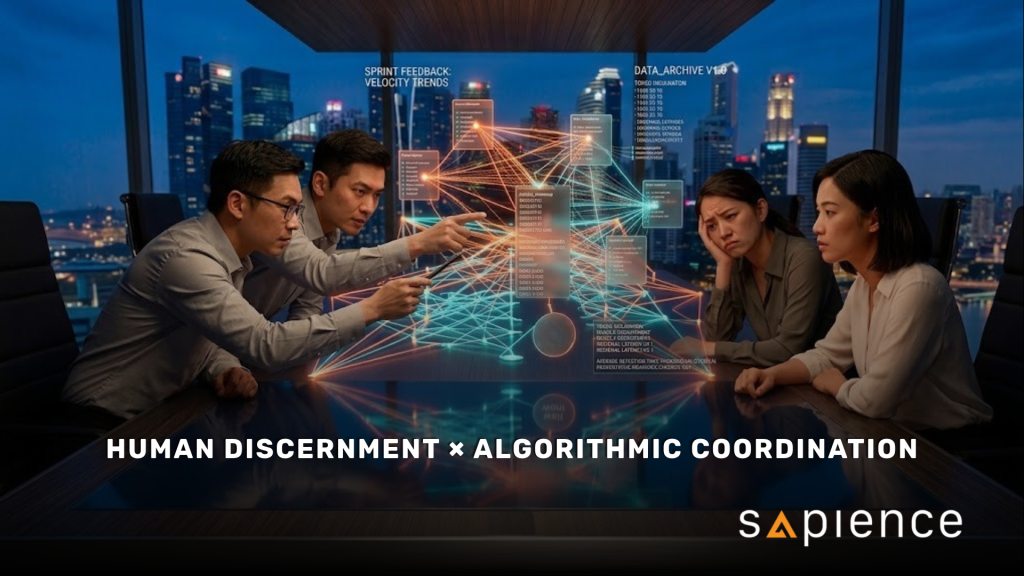
When routine coordination becomes instantaneous, the human conversations that remain are the ones that actually define success: priorities, ethics, edge cases, and genuine trade-offs.
The New Temptation
As artificial intelligence becomes more capable, agile teams face a subtle but pervasive temptation: confusing faster coordination with a reduced need for collaboration.
Today, AI can summarise complex requirements, draft user stories, translate technical nuances into business language, and suggest trade-offs across product, design, engineering, testing, and delivery. On the surface, that makes cross-functional work appear far simpler. It inevitably tempts some teams to question whether they still need as much discussion as before.
The same temptation surfaces in agile retrospectives. If an algorithm can cluster sprint feedback, categorise recurring friction points, and draft improvement actions in seconds, teams naturally begin to wonder whether retrospectives still require the same depth of live reflection and debate.
These are understandable questions, but they overlook a deeper reality: AI does not remove the need for collaboration; it fundamentally shifts where collaboration matters most.
Why Collaboration Still Matters
Cross-functional collaboration was never valuable merely because information had to be exchanged by hand. It matters because individuals from different disciplines perceive different risks, different trade-offs, and competing definitions of success.
Design vs. Engineering
A designer often spots user friction where an engineer sees elegant, flawless logic.
COMPLIANCE vs PRODUCT
A compliance lead identifies regulatory vulnerability where a product manager sees seamless user conversion.
AI can certainly help these specialists understand one another faster. It can turn fragmented working notes into crisp briefs, surface obscure architectural dependencies early, and make handoffs markedly cleaner.
THE CROSS-FUNCTIONAL PARADOX
AI reduces mechanical coordination effort, but it dramatically increases the importance of high-quality collaboration.
When routine translation is automated, the conversations left on the table are the difficult ones: ethics, edge cases, sequence dependencies, and hard trade-offs. Relying on AI to mediate every exchange risks eroding the rigorous thinking that takes place when colleagues challenge each other’s assumptions in real time.
What High-Quality Collaboration Looks Like in an AI-Assisted Team
In high-performing teams, AI is never treated as a final arbiter. Instead, high-quality collaboration manifests in three deliberate practices:
1. Debate First, Prompt Second
Product, design, and engineering meet to debate the core problem statement before querying AI to surface edge cases, regulatory constraints, or non-obvious failure modes.
2. Relentless Inquiry
The team routinely pauses to ask, “What are we not seeing here that the model cannot know?” before committing to an architectural path.
3. Intentional Pushback
Team members actively interrogate AI-generated priorities, treating automated outputs as a conversational baseline rather than an authoritative roadmap.
Retrospectives in the AI Era
Retrospectives face this exact tension. AI can summarise Slack and Jira threads, cluster repeated complaints, evaluate velocity trends, and draft sensible action items directly from sprint metrics. For distributed and remote teams overwhelmed by written chatter, this capability is invaluable.
Yet the primary value of a retrospective has never been the summary. The value is shared reflection.
This is precisely where teams stumble. When AI delivers neat conclusions prematurely, team members often bypass the uncomfortable conversations that build accountability, candour, and ownership. A team presented with a tidy summary such as “testing delays were caused by ambiguous acceptance criteria” may readily nod and move on. In doing so, they miss the vital questions:
- Why were those criteria unclear in the first place?
- Who first sensed the ambiguity, and why did they hesitate to speak up?
- What systemic pattern links this delay to earlier sprints?
Guarding Against "Summary Compliance"
The solution is not to banish AI from retrospectives. Rather, teams must treat AI as input, never closure. AI excels at collecting and structuring raw signals, but the human team must interpret those signals, challenge the narrative, and determine what truly matters.
⚠️ Beware of “Summary Compliance”
A subtle risk where everyone in the room passively assents to an automated summary simply because it reads smoothly, sounds neutral, and avoids interpersonal friction. Polished consensus is not the same as genuine alignment.
- Prepare Themes Prior to the Session: Use AI to aggregate raw feedback before the retrospective starts, freeing live time for discussion rather than administration.
- Interrogate the Gaps: Do not merely ask whether the summary is accurate; ask: "What critical context has this summary omitted?"
- Separate Pattern Recognition from Action Selection: Allow AI to flag recurring delivery patterns, but insist that the human team chooses and scopes the corrective experiments.
- Elevate Facilitation: The facilitator's role shifts from tedious data collection to safeguarding psychological safety and drawing out constructive disagreement.
Sharper, Faster, More Honest
Does AI reduce the need for cross-functional collaboration? Not at all. It strips away administrative friction, but it places a premium on human discernment, trade-off evaluation, and collective ownership.
“The winning standard in modern delivery is not raw speed of consensus — it is the depth of reasoning behind every collective decision.”
The teams that lead the next decade will not be those who talk less because an AI tool is present. They will be the teams that use AI to make their most critical conversations sharper, faster, and unapologetically honest.
As a trusted leader in professional development, Sapience empowers you to invest in your future.
Don’t wait – Explore our available funding and leverage our expertise to upskill without financial strain.